Sunday, 26 February 2023

Yr 9 Reading Pragramme

Struggling Readers

Most of our students obtain a Stanine 3 or 4 grade in the PAT Comprehension tests. This means their reading ability is two, three or more Curriculum Levels below that of their peers. The question here that is often not addressed is, why? This means that in a Secondary situation, the skills that need to be taught are not taught explicitly. Students with low Stanine scores can read but their comprehension skills are weak. If these students are to progress they need reading tasks that help them develop their reading skills. To address the learning needs of these students, curriculum staff need to help students overcome their perceived helplessness when faced with a reading task.

This involves showing students how to take control of a reading task by showing them which strategies to use so they can comprehend what they read. For students to see success in their reading they must be shown how a strategy will improve their understanding. For example, students know what 'word attack' skills are but they do not regularly employ these Primary taught skills when their comprehension of a text breaks down. Often students have a single reading speed and they do not slow down when the text is difficult. They do not employ their word attack skills when they are needed. Reminding students what word attack skills are and how and when to use them is the first step.

Chopping up the text into manageable chunks also helps struggling readers.


Providing students with an information transfer also helps. It forces students to reread the text. Get them to do this in silence first rather than letting them collaborate. Providing students with a structure-based template to fill in helps students use the order of the texts as clues that aid comprehension. The topic sentence is followed by details, the big picture is followed by close-up details, and details are followed by an instruction (Maths Text). Discussions of these features help students develop self-awareness about the skills they already use but also shows them what they must strengthen in order to improve.

Setting a goal for each reading task is also important. I am reading this text to develop an understanding of how plants grow. I am reading this text to fill out an information transfer about the important aspects of photosynthesis. I am reading this text in order to take part in a discussion about where our food comes from. Lastly, students are often unaware of the strategies which they must employ to comprehend a class reading. Comprehension strategies need to be explicitly taught through guided instruction but just as important students need feedback on their comprehension. This can be achieved by marking their information transfers or by using a rubric to mark student summaries of a text.

Friday, 21 May 2021

Technology Departmental Meeting 20/05/21
This is an example of peer teaching. The idea is to go beyond the usual support we give students for a writing task, i.e. paragraph templates, sentence starters and examples.  Back in the 1960s Halliday was responsible for us adopting the non-grammar position because native speakers of English intuitively know the structure of the language. Many of our students do not understand the difference between the spoken and the written form of English. Many of our students must get despondent when their attempts to write a fluent paragraph fail. The point of the posters and the shared writing task is to make fluency and content issues explicit.  The use of the functional grammar approach here is a way to reduce to a minimum the number of features students must focus on in order to improve their writing. No one wants to overload teachers with yet more learning initiatives but it is hoped that teachers can help students with these basic grammar features: noun groups, opinion statements or modals, and verb groups. This, combined with shared writing tasks and the white board presentations, encourages students to take risks. The instant feedback on the white board also works wonders. I'm happy to work with class on a specific writing task. All I need is a student exemplar of the finished product. I'm happy to take the written model and adapt it into a few literacy tasks and then to work with a class on a shared writing task and presentation. Bish bash bosh but never bosh bash bish. Shared Writing Task and Group Presentations

Friday, 7 May 2021

Friday's Slam at the Staff briefing involved a summary of working with Hinerau Anderson on scaffolding reading tasks and on monitoring student comprehension.  Climate Change is a huge topic and the authors of each text exhibit an inherent expectation the reader has a huge amount of background knowledge. Often our students do not have an understanding of these huge topics, so the scaffolded reading tasks are used to make comprehension skills explicit while at the same time bringing the content to the fore. This is achieved by setting tasks that encourage students, in small groups, are to talk about the text.  The teacher was able to monitor student progress in comprehension by prompting students to improve their summary writing. When a student claimed, in their summary of the text, that he or she 'learned a lot,' the teacher was able to quickly prompt the student. This involved asking the student to detail exactly what they had learnt. The student was encouraged to use topic words from the text and they were also asked to explain why this information was relevant or important.  The use of authentic texts was also important along with provocations and enquiry prompts. Texts on what students can do themselves about reducing greenhouse gases and complex texts about carbon isotopes were also found for the students. This was done to avoid the rabbit hole student use of material from conspiracy theorists. That can wait for another day. The next step is a windows and mirrors moment where texts will be selected which look at the effect of global warming on Pacific Island and on New Zealand Glaciers.
Literacy Strategies - Year 10 Project | Climate Change and Game Development

Tuesday, 28 August 2018

All this technology is making us antisocial?

You could argue technology is making us more social, rather than anti-social. We spend more time communicating in new and often novel ways, more than ever before. Where once the Newspaper was our smoko addiction, we now have the unlimited ability to communicate across the world with friends and associates, even if it means we are ignoring the person sitting beside us.

Thursday, 23 August 2018

Information Transfers: Science, Maths and Beyond.

https://docs.google.com/document/d/e/2PACX-1vRZbRij_cPcNPQ6UANpgWEGkkGRd7vAXvW6tuCTiQgb3w9p4KQXczamXDBHpiw22JanF7B26kWSwhd2/pub

Friday, 25 May 2018

Friday afternoon 25 May      Year 10 Social Studies      Amazon Rainforest 

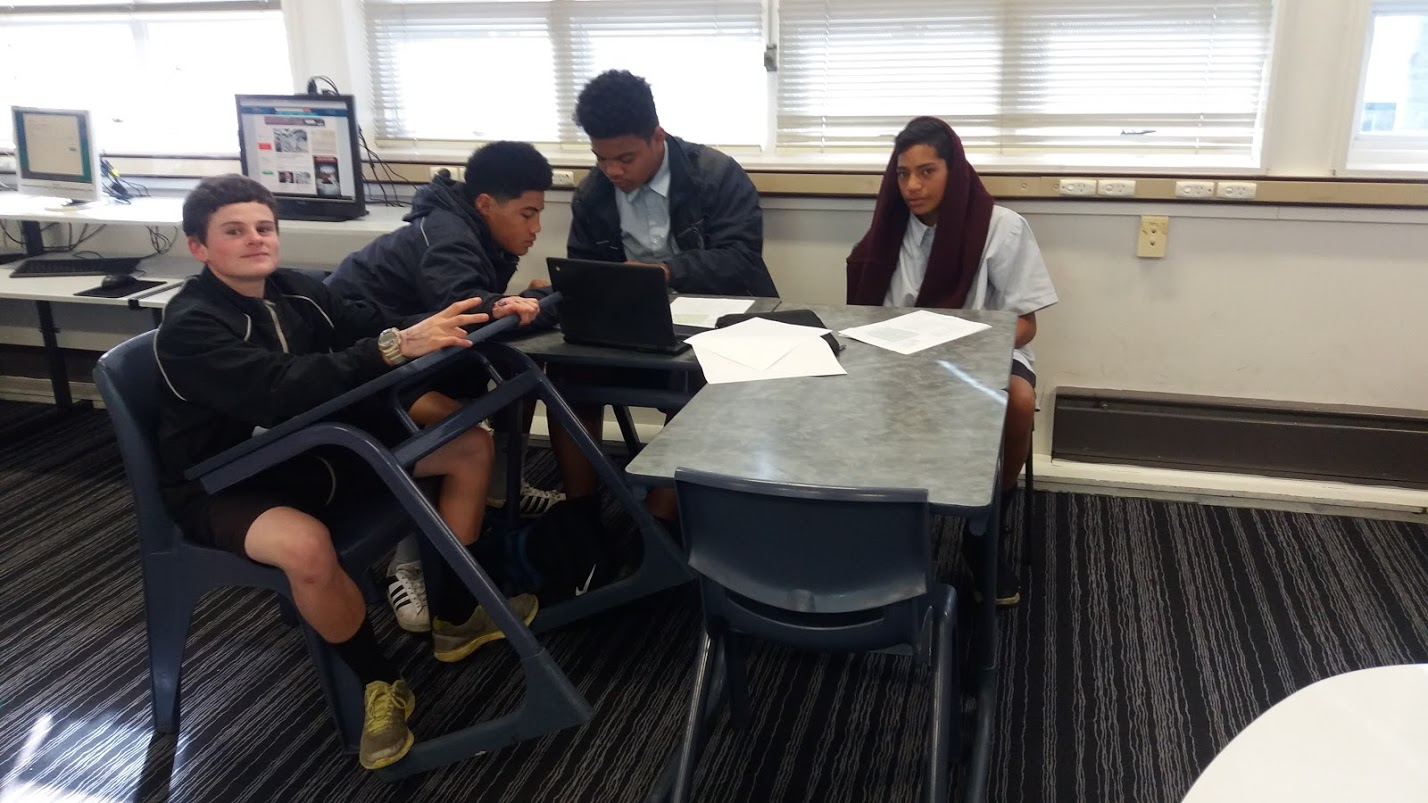
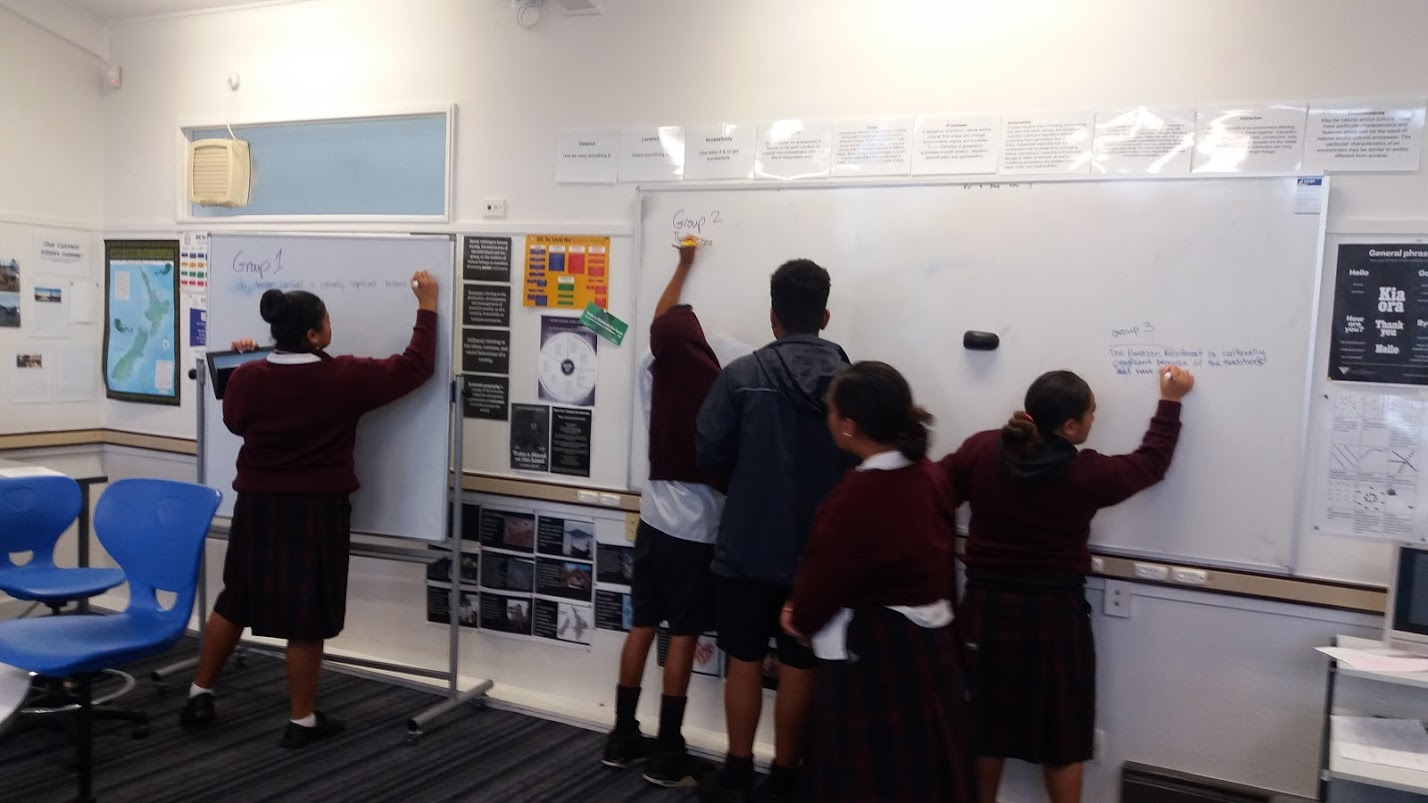
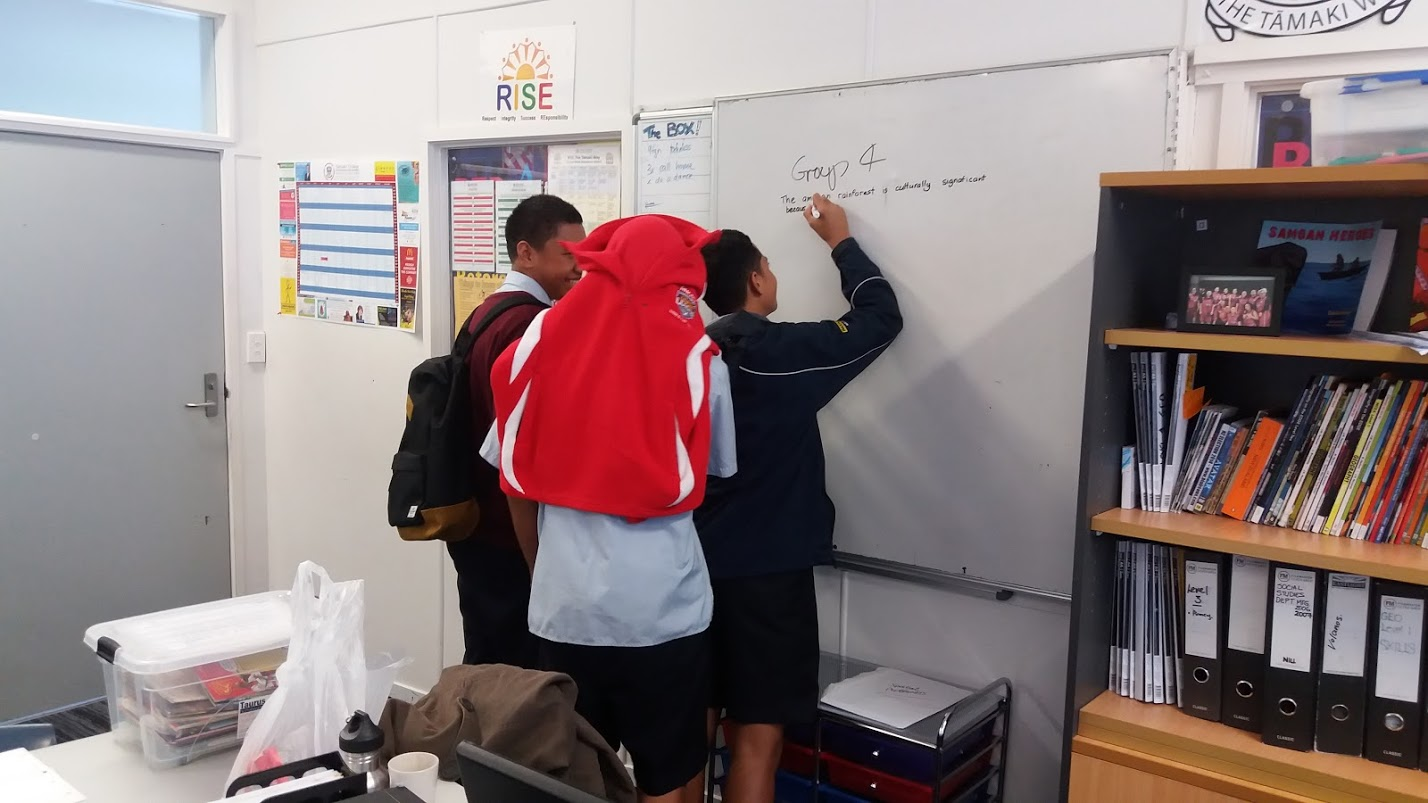
A feature of the Writing Plan for 2018 is a teaching strategy which ensures students are Talking About the Texts they are required to write. In Judged Group Writing Tasks students work in small groups on a set writing task.

Usually, students are asked to draft a paragraph, one which is similar to the assessment task. An exemplar is used to model the requirements of the writing task. The teacher may want students to focus on sentence starter use, grammatical features such as modality or content details and vocabulary chains.

Prior analysis of student exemplars from 2017 indicated that students who did not reach the standard did not use all sentence starters. Students also tended to include two or more subjects in a paragraph without linking them in a significant manner.

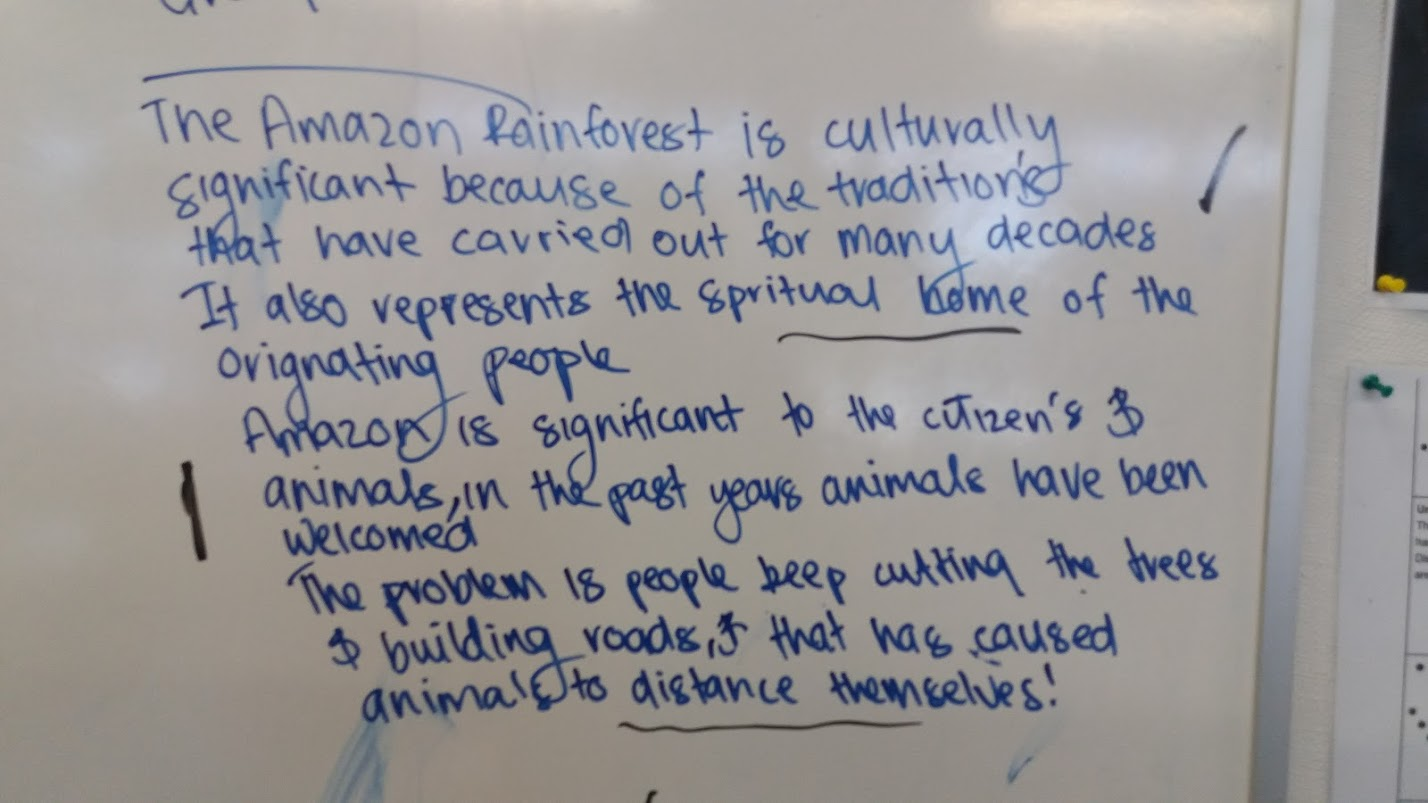
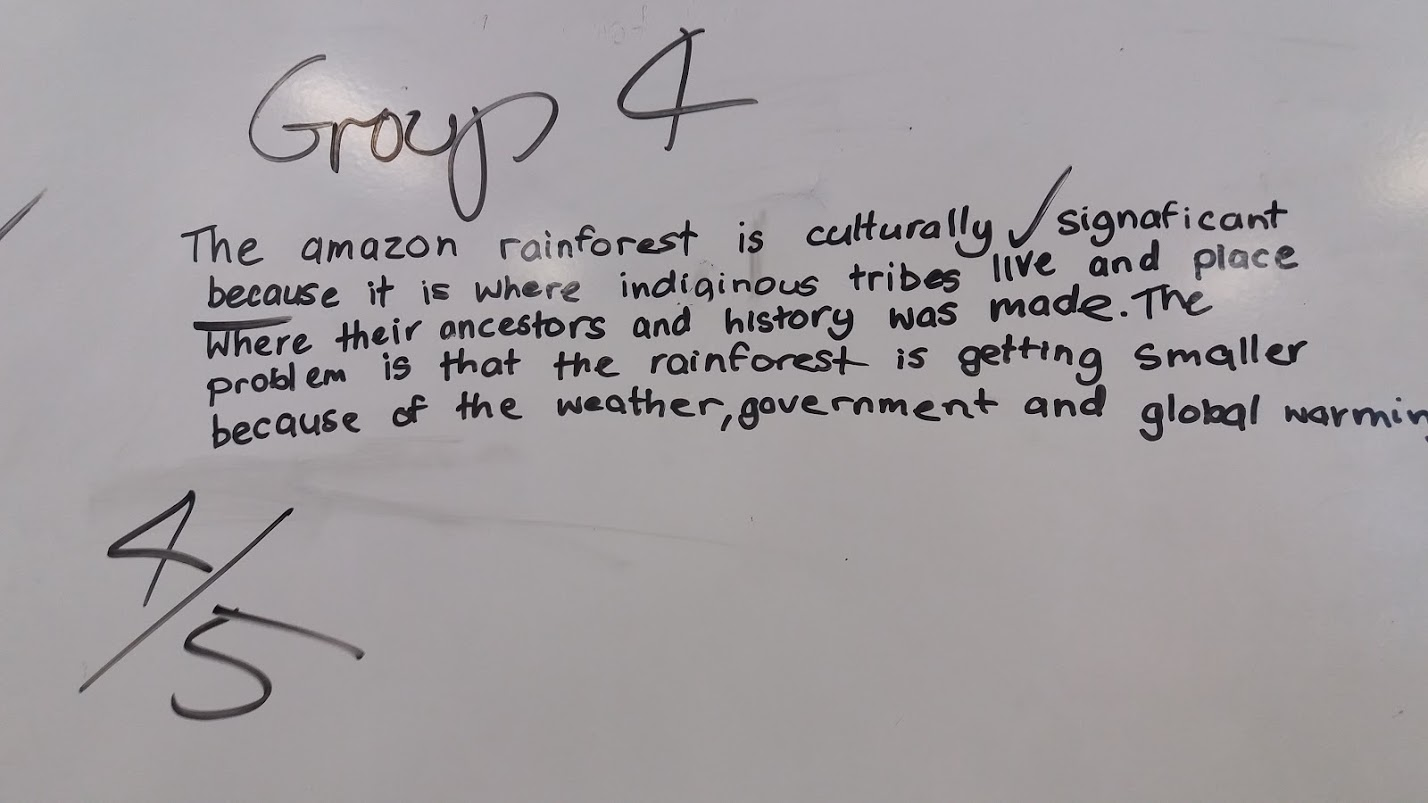
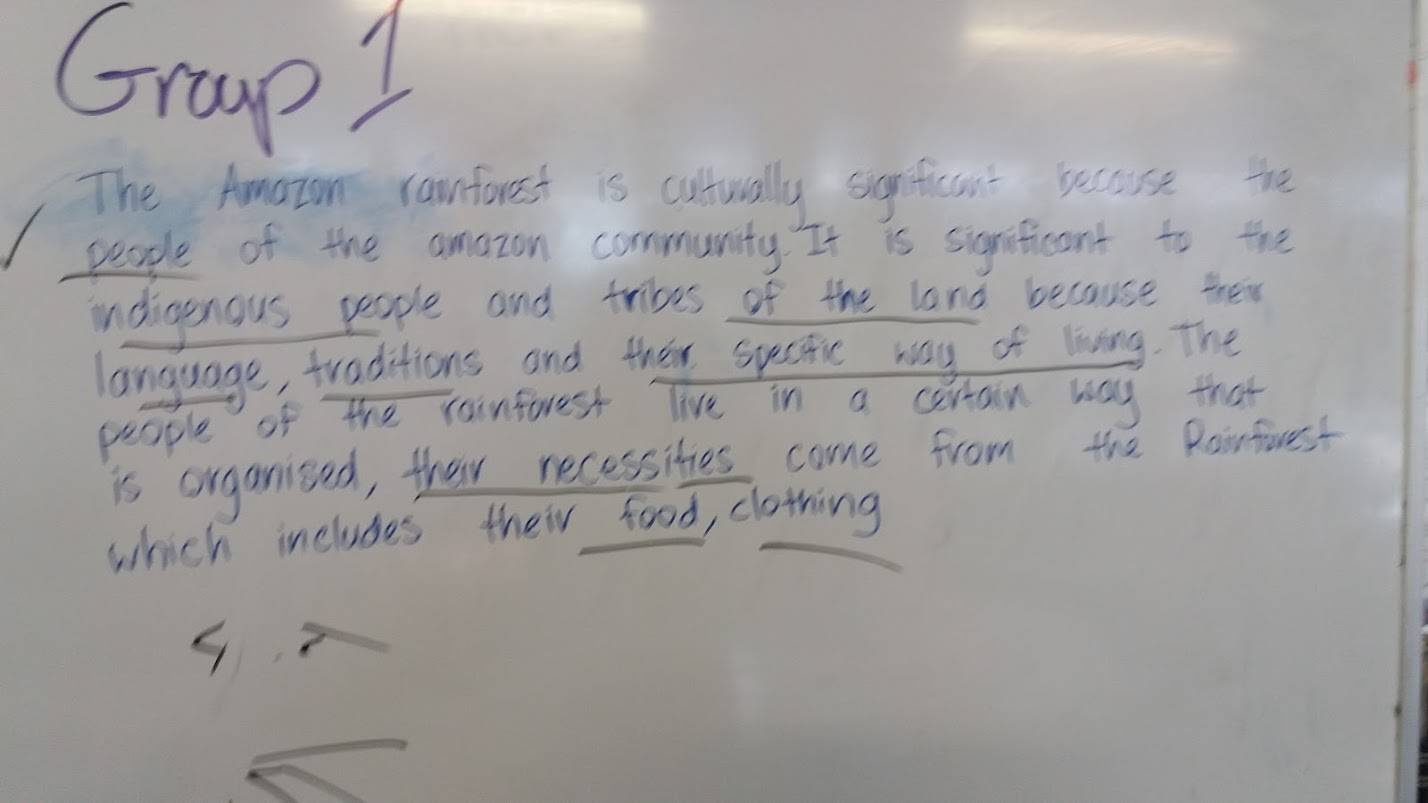
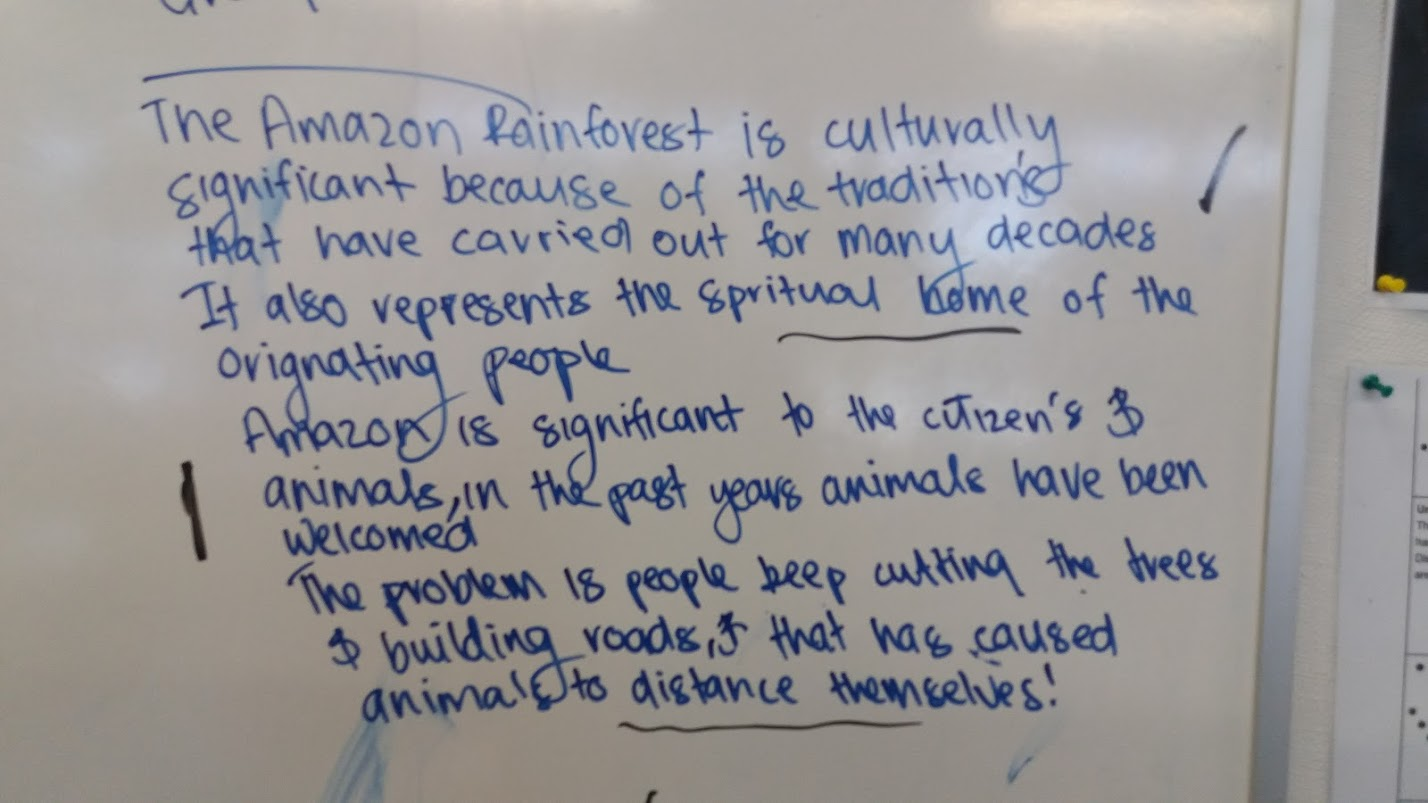
The sentence starters were:  The Amazon rainforest is culturally significant because....
                                                .....it is significant because.....
                                                the problems are........

Because each student group is required to draft a paragraph which is then presented and judged, students begin to Talk About the Text.
As there is a competitive element to this strategy, student involvement increases dramatically. Students who are reluctant writers or hoha often change overnight and enthusiastically participate,  correcting the work of the peers.

This strategy requires the teacher to judge, dialogue and then grade the work of each group. e.g. "I'm going to give this paragraph a 4/5 because it has .........." This is an exciting way for students to work on a writing task and to contribute without feeling whakama. i.e. students can spread the mahi.

One drawback of this method is the need to set deadlines during the lesson, for writing the draft and for the student presentation of their paragraph. This is needed so there is time for the teacher grading of each text. This means there is a class discussion about the quality of each text or talk about the text. In this lesson, it was a little rushed but it is still possible to give relevant feedback which can be discussed during the next class.


-good use of the sentence prompts x3
-good topic/vocabulary chains
e.g.   rainforest, traditions and spiritual
        home
e.g.   rainforest, animals and cutting trees
        and building roads
-but the paragraph tries to explain two different topics,
the two halves are not linked  
-the two halves could be linked by explaining the
traditions which the indigenous people use to limit
their hunting of various animals
-vocabulary examples which could improve this
paragraph are: indigenous people, in the past
animals have been protected, and, the habitat of
many animals are now threatened because the trees
are being logged.


-good use of the sentence prompts x2
-good topic/vocabulary chains
e.g.   rainforest, indigenous tribes,
        ancestors, history
e.g.   rainforest, smaller, weather,
        government and global warming
- the two halves of the paragraph are linked
 by the word smaller, the rainforest is
 getting smaller, but the link is not strong
-to improve the link add details which show that
the place they live, the rainforest is the place where
they get their food, their clothing and where they
build their shelters.


-good use of the sentence prompts x2
-good topic/vocabulary chains
e.g.   rainforest, indigenous people, tribes,
        a specific way of life
e.g.   rainforest, a certain way, their
        necessities, food, clothing
-the two halves of the paragraph are linked through
the use of, their specific way of life and their
necessities
-to improve the link add details about using the
rainforest to hunt or collect food or collect material to
make shelters.
To improve fluency link sentences using, because,
this is because, in addition, besides


Thursday, 24 May 2018

It's a technology lesson Jim, but not as we know it.

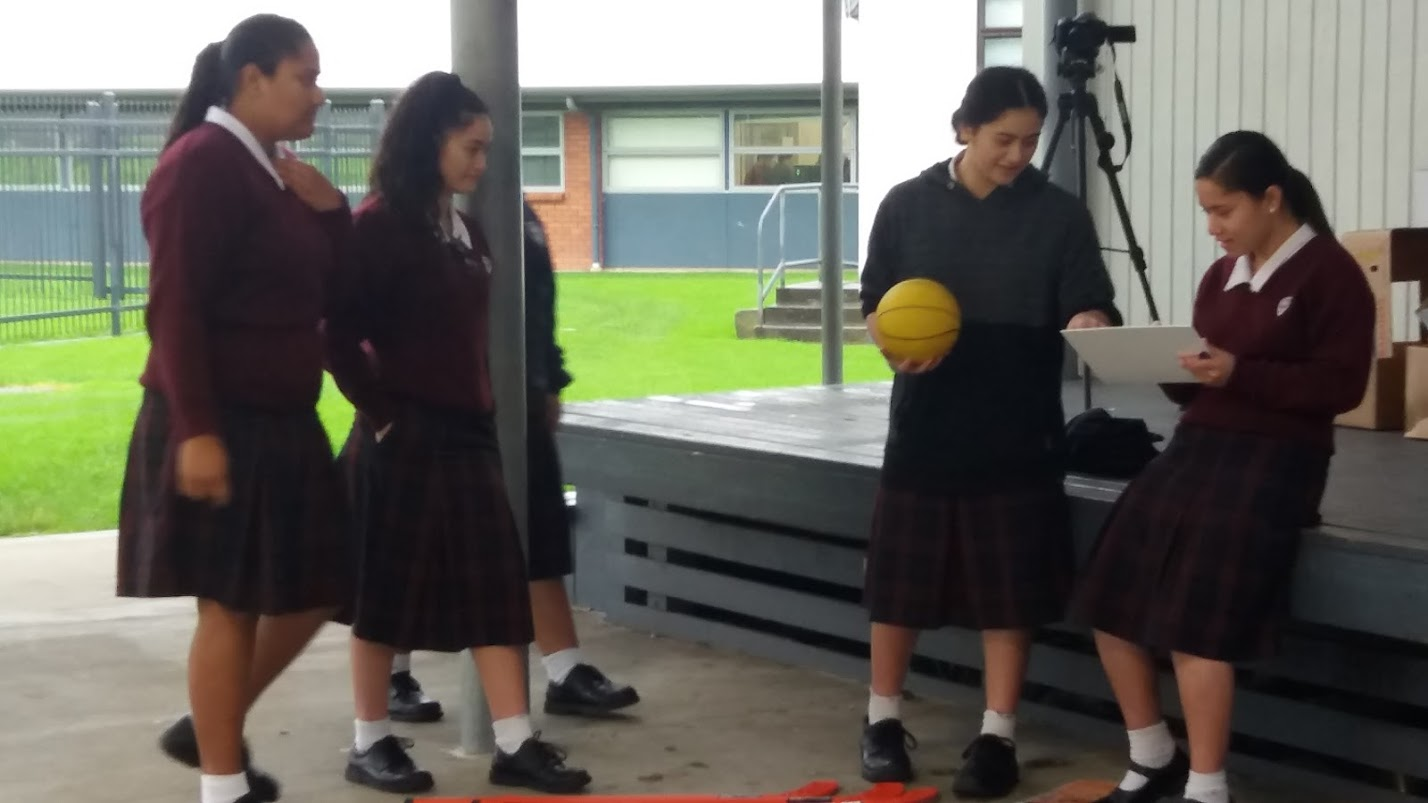
I watched a fantastic technology lesson today. The teacher wanted her students to understand how a design process develops, one where the participants are engaged and where they must communicate with each in other to progress an idea. The teacher also wanted the students to develop their understanding of two key concepts of a design process. This was based on the key design words, Switch and Adapt.

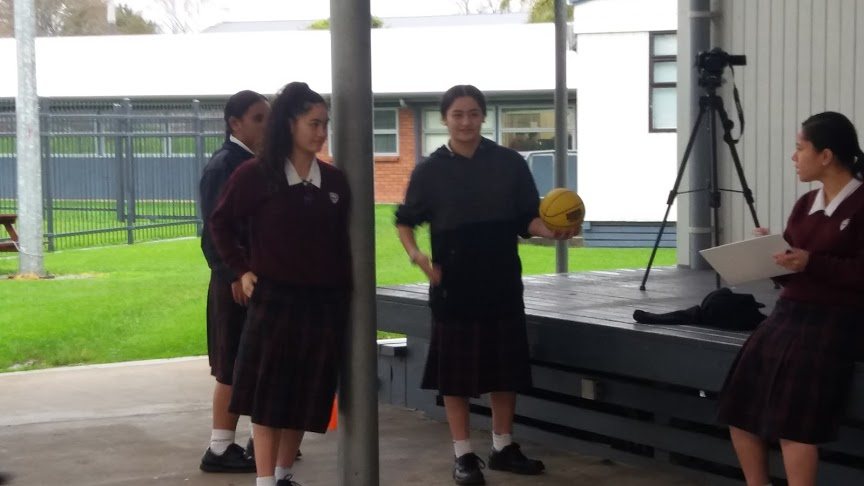
So instead of sitting at their desks pouring over design diagrams, it was out into the playground to play a game. The students were given a ball, shashes, hoops, cones, hockey sticks, told to stand in a circle and told to 'play ball!' Nonplussed, the students automatically started passing the ball around the circle. At various intervals, the students were asked to improve the quality of their basic game by adding rules. This was the Switch but students could also Adapt their rules by modifying each rule.


Eventually, the game evolved, until there was a rotation of three teams, cones, a points system and a set of penalties. For example, when a student dropped the ball that student was required to do a pushup. This worked well until one student exclaimed that there was no rule which enforced the push-up rule  -well done that man. The best comment and the point of the lesson came from a student on the way back to the classroom. "Ms," he asked, "what is the point of having a game if there are no rules?" This lesson embedded a design process which both the teacher and the students will be able to refer back to as they work on their design tasks. The lesson helps the students notice and it helps them care about a process that often only happens in their heads. Thanks, Karen